

The Cheapest Margin in Your Building
Costs Are Up, Sales Are Flat, But the Tool That Fixes It Is Already Installed
By Howard McAuliffe, Partner, Pinnacle Entertainment Group

Food services and drinking places rang up $102.5 billion in June, up 3.8% from a year ago. That’s the Census Bureau’s advance retail report, released July 16, and on its face, it looks like growth. Now subtract the 3.4% that menu prices rose over the same 12 months, per the June CPI. What’s left is about four tenths of a percent of real growth. That’s the out-of-home entertainment dollar right now: it looks like a gain on the P&L and it’s flat on the floor.
The cost side isn’t flat. Average hourly earnings across private payrolls are up 3.5% over the year. Electricity is up 4%. Service-sector firms surveyed by the Richmond Fed this cycle reported non-labor input costs running above five and a half percent, and the Fed’s July 15 Beige Book has plenty of contacts saying they’re absorbing those increases rather than passing them along, because they don’t think the customer will take it. We can’t just raise prices yet again.
We can’t control any of that. We can’t control fuel, we can’t control what a case of plush lands at, and we can’t control whether a family in our market got a raise this year. What we can control is how much of the money already walking through our doors we’re actually capturing. And for most of us, the single cheapest place to find that money is a system we already bought, already pay a service contract on and use at maybe a third of its capability.
What’s Actually Breaking Isn’t the Door Count
Here’s the part the press keeps getting wrong. The story in 2026 isn’t that the customer disappeared. The Conference Board’s July 28 read had consumers saying they intend to spend more on services over the next six months, with restaurants and amusement parks named specifically. They’re coming. They’re just behaving differently once they get here. Customers are looking for value.
The Richmond Fed had a detail this cycle I haven’t been able to stop thinking about. A luxury salon in Northern Virginia reported that customers are still spending on the expensive treatment, but they’re “waiting longer between hair appointments and getting fewer add-on services.” A large retailer in the St. Louis district said customers “were making more frequent trips but purchasing less per visit.” Richmond summed up the whole district this way: there were reports “across all consumer income levels of trade downs and tradeoffs needing to be made.” All income levels. Not just the bottom.
Translate that into our buildings and it’s exactly two numbers: how often they come back, and how much they attach on top of the thing that got them in the door. And your card system allows you to address both.
Driving Return Visits
Most FEC owners and street operators use their card system to eliminate paper tickets, accept credit cards and control their cash. If they open their reports at all, it is to check sales and maybe payouts. All these uses make it worth owning a card system but why not also use it to increase traffic and sales?
I have frequently mentioned “Bulk Encoding” in columns but will do a deep dive here on how to use it. We use Intercard for our facility and the vast majority of our consulting customer locations, so it is the system I know best (and full disclosure, they are a client). I am going to use report names and features in Intercard; other systems have similar features so ask your vendor how to access them. Bulk Encoding game cards allows you to take a group of game cards, input the amount of cash and bonus you would like to offer, provide a bouceback offer, name them as a group and then subsequently track the results. Here is an example of how to use it.
The local school we’ll call “Greenbriar” is bringing 100 kids for a field trip. We offer them $20 in game play for only $10. Before the group arrives, we make 100 cards input $10 in cash and $10 in bonus play, plus a $10 bounceback offer. We set the bounceback offer to start the day after the event.
Ideally, we presell the cards, so we just hand them out to the kids, however sometimes the school doesn’t want to manage that, so we just offer them for sale at the desk. It’s essential to announce and tell the kids to keep the cards because starting the next day they will have $10 in game play for free they can use for two weeks. Now, we can pull a report in two weeks and see exactly how many of those cards used the bounceback offer and how much they reloaded onto the card.
This lets us keep a database of groups and how much they are really worth. You’ll find some groups are very likely to reload and return, while others are not. In addition, you’ll start to understand what bounceback offers drive return visits.
Using your Card System to Add Value
How do guests value their experience in the arcade? We use the following formula:
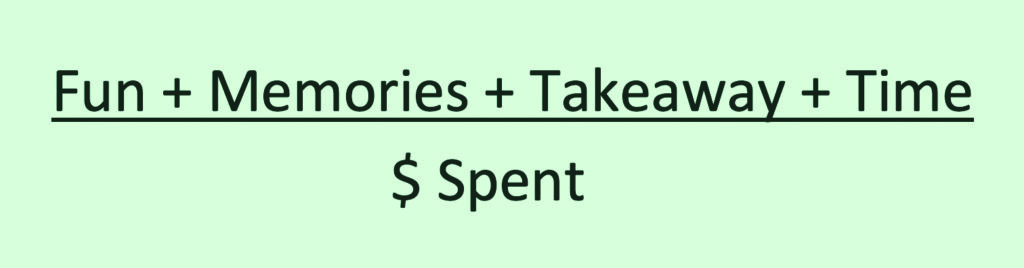
Your card system can directly enhance the value of the time portion and the dollars spent. How much time does your guest need to really experience the arcade? Set your bonus pricing at those levels. Two tips:
1) A $5 card does not give them a good experience.
2) Increasing your pricing at the game does not give you more revenue, it gives the guest less value because it reduces their time in the arcade.
The way to maximize value is to ensure you’re giving guests a great experience while maximizing the amount they spend in the arcade. Your pricing at the teller can incentivize them to choose to spend more because they get more value. How you set that pricing is key to maximizing spend and there is no one size fits all “best pricing model.” Think about your customers and what they can spend, and target value to the key demographics in your center. Measure your average transaction value in the card system to see if it’s going up. That’s is how you measure whether you are successful or not in changing pricing.
Do the Math
When you begin bulk encoding for groups make sure to pull the reports regularly to measure how much guests reload and how many use the bounceback offer. This allows you to really value which groups are your most profitable, as well as which offers are most successful. When you try new pricing models at the teller, it is essential to measure average transaction value. The best way is to pull your teller product sales mix report or similar in card systems that aren’t Intercard. Simply total the sales and divide by the number of transactions, that gets you the average transaction value at the teller.
It is essential to measure the impact of your programs over time, continue to revise and improve, and if you make a mistake, quickly correct it. Consumer behavior is changing. It’s important that we constantly monitor and track how it is changing in our industry and, more importantly, how we can use these changes to offer guests more value so they spend more at our facilities.
I welcome your feedback, positive and constructive alike. Email me at [email protected].
Howard McAuliffe loves to imagine and implement new products, business models, and ideas, and is CEO and president of Pinnacle Entertainment Group Inc. He’s an industry veteran who got his start in the business when he was just 16 and has 20 years of expertise in product development, as well as FEC and route operations. Howard’s wife Reem and young son Sami are the center of life outside of work. When he’s not working, Howard can be found enjoying the outdoors, hiking, fishing and mountaineering. Traveling anywhere new or to old favorites like the American West is a passion. Readers can visit www.grouppinnacle.com for more information or contact Howard at [email protected], he welcomes positive as well as constructive feedback and counterpoints.