
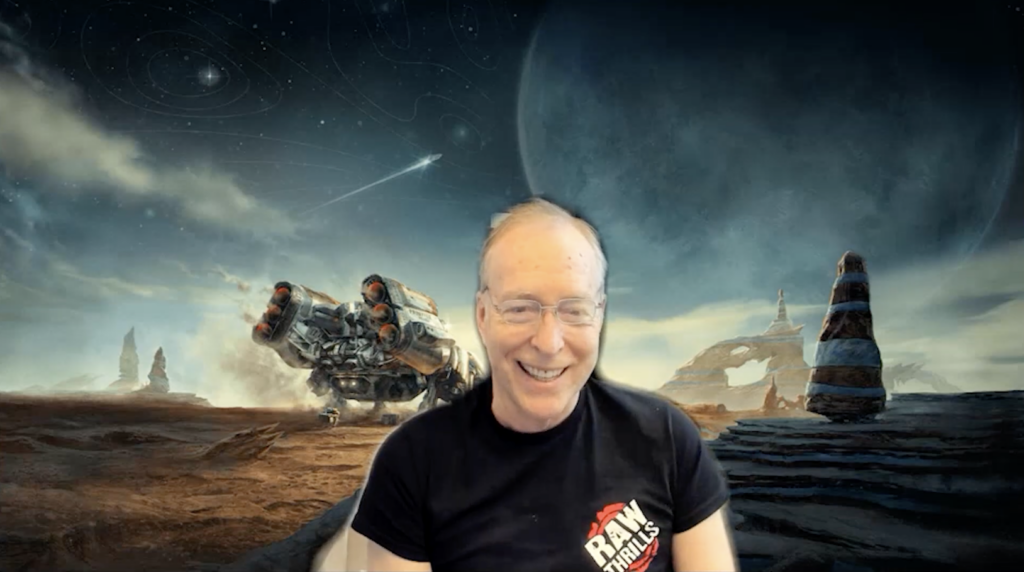
One of the pre-eminent video game makers ever, Eugene Jarvis joined Episode 12 of the RePlay Podcast with host Randy Chilton. He spoke at length about his nearly 50-year career, which started at Atari in the late 1970s and soon onto Williams. (CLICK HERE TO WATCH!)
One of his first claims to fame was doing the programming and sound on Steve Ritchie’s first pinball machine, the 1977 Atari game Airborne Avenger. When Steve moved over to Williams, he invited the California kid Eugene to a snow-covered Chicago in March 1979.
“I was thinking, ‘I’m never going to come here – ever,’” Jarvis recalled. “Then somehow one year later I said, ‘Hell with it.’ I just loved pinball too much and wanted to work with Steve and make some pins.”
He also worked with another legendary pinball designer, Barry Oursler, on Gorgar (1979), which was the first talking pinball machine. The second such game was Firepower (1980), which was a Ritchie-Jarvis machine. That one was also the first multiball pingame.
It was at Williams, after a bit more time working on pinballs, that he tried his hand at video games. Of course, the game that came from his effort was 1981’s Defender. “That was the biggest game I did,” he said. “My first and biggest game. I’ve been working the last 45 years trying to make a better game and I’m still working on it.”
As expected, Jarvis still has one at his house today. “I play it now and again, but my scores are falling,” he said with a laugh. “I’m really more addicted to my game Robotron. I enjoy kicking in the coin door on that one.”
He explained that game, Robotron: 2084, which came out in 1982, was a result of Williams not giving him a bonus on Defender. He and fellow Amusement Industry Hall of Fame inductee Larry DeMar, who also worked with Jarvis on Defender, started their own development company called Vid Kidz and published Robotron through Williams. (Their first Vid Kidz game was Stargate, the 1981 follow-up to Defender.)
Shortly after, the video game crash hit. “It was over – it was like disco or the pet rock. Everybody either got laid off or quit and we all went our separate ways for a while.” It was at that time that Jarvis ended up going to Stanford for his MBA.
All told, Jarvis worked on pinball games for about a decade. His other games with Barry O were Laser Ball (1979), Time Fantasy (1983), Star Light (1984) and Space Shuttle (1984), which Oursler co-designed with yet another industry icon, Joe Kaminkow.
He also worked on Firepower II (1983) with Mark Ritchie and a couple other Steve Ritchie machines – High Speed(1986) and F-14 Tomcat (1987).
Jarvis resigned from what was then Midway and worked as a contractor to develop a new 3D hardware system “that eventually became the Cruis’n games of the ’90s.”
“It was pretty amazing. We had six guys – two hardware guys, two programmers and two artists. It took us about four years to get this thing done. We developed basically the equivalent of a Sony PlayStation – actually more powerful than that – and did the game Cruis’n USA.”
By the late ’90s into the early 2000s, in an oversaturated arcade game market, Jarvis had plans to develop a consumer game and co-founded Raw Thrills in 2001 with Andy Eloff and Deepak Deo.
But after running out of money for the project, it turned into a make-what-you-know push toward what eventually became The Fast and the Furious (2004). Just before that, also in 2004, they released their first game, Target: Terror.
“What’s shocked me is this company’s been going for 25 years,” Jarvis said. “From that whole cataclysm of the early 2000s we as an industry kind of went back to our family entertainment roots. … It’s the best job in the world if you can hang in there.”